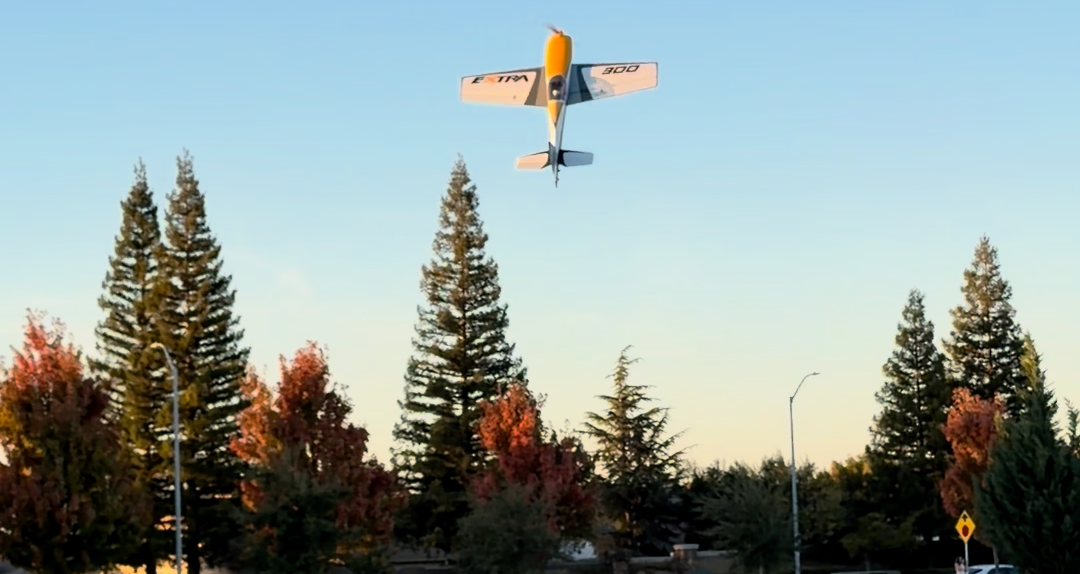
Harrier rolls. Flat spins. Pop-tops. Torque rolls. We’ve all seen some or all of these moves, and we all want to be able to fly them to show our absolute mastery of model aviation. How do you even start though when everything is a blur of flips and spins? This article will explain how to perform, practice, and master these moves, and by the end, you’ll be ripping around the flying field doing all of the cool stuff you’ve always wanted to do but couldn’t quite yet.
Step 1: The Equipment
Have you ever seen someone win a Grand Prix without having a fast sports car? Didn’t think so. The same applies to learning 3D. If you have a Carbon Cub 1.3m, you will NEVER do any good 3D, just as a Toyota Corolla cannot beat a Ferrari in a race. It is not a skill issue by any means, it is simply an equipment issue. If you want to do good 3D flying, I would recommend starting off with something like an Eratix 860mm if you fly in smaller spaces or an Extra 330 1.3m if you have more than a park to practice at. Also, get the highest cell battery the plane can take but, if possible, make the battery also low on mAh. An example of this would be: The plane can take 3S-4S 2200-3200mAh batteries, so get a 4S 2200 or 4S 2700mAh battery. This way, the battery will be as lightweight and powerful as possible. Lastly, if you have weak foam hinges, put reinforced hinges on the airplane. You will otherwise have risk of watching an elevator departing the plane and then seeing as it proceeds to become a lawn dart soon after. (Strong tape hinges worked for my Extra 300 1.3m).
Step 2: Training
Now to the good part. If you want to get good at flying 3D, you have to train and practice a whole lot for a long time to get the muscle memory fine-tuned enough to not crash. I would STRONGLY RECOMMEND PRACTICING ON REALFLIGHT FIRST! This way, a mistake of your orientation doesn’t end the plane and result in a crater. When in RealFlight, constantly practice the moves you want to learn.
- Harrier Rolls: These are done by pitching into high alpha, turning to a knife edge while holding rudder to keep in high alpha, going inverted and pushing to keep high alpha, another, this time reversed, knife edge, and then regular high alpha again. Now, put these all together in a fast spinning motion to achieve a harrier roll. Hardness Level: 2
- Rifle Rolls: These are basically harrier rolls but the airplane is totally horizontal instead of in high alpha. Hardness Level: 1
- Hovering: Start by slowing your airspeed to just about a stall, and go into high alpha as lift becomes more and more reliant on your propwash. Keep getting to a steeper and steeper angle, precisely applying power to keep the aircraft stable, until you become totally vertical. This feels like balancing on the point of a pin. The aircraft will now try very hard to depart the hover and make itself spin around the roll axis (this is a torque roll). Hardness Level: 3
- Torque Rolls: A hover but you let the plane spin around the roll axis while hovering. This requires better muscle memory and mastery of orientation to pull off. Hardness Level: 3.5
- Slow Rolls and Point Rolls: Point Rolls (4-point, 8-point, etc.) are a type of roll where you spin the aircraft to an angle, compensate loss of lift with rudder and elevator input, and then move on to the next angle in the sequence. You go through each part of the turn, compensating all of the way, until the aircraft is upright again. Meanwhile, a slow roll is just the same thing but constantly rolling at a slowish speed all the way through the roll. Hardness Level: 1
- Pop-Tops: Pop-tops are a stick-jamming maneuver where you more or less put the sticks in the opposite top corners of your transmitter at the top of an upline and hope for cool blender-like spinning but upwards. I know this looks like a hard trick, but it literally requires no skill at all, just luck. Proof? Greg will fly his UMX Air Tractor through this trick while paying attention to me taking off. Hardness Level: 0
- Flat Spins: Whether right-side-up or inverted, this trick is done by doing a vertical climb and then stick-jamming both sticks to a bottom corner (or left stick at a bottom corner and right at corresponding top corner for inverted) and hoping things work out. Just make sure to pull out in time to not hit the ground, as your wings are producing no lift at all when in the maneuver. Hardness Level: 0
- Knife-edge Spins: Basically a flat spin except stick-jamming doesn’t do the trick. You do a pop-top (or something else that results in a similar orientation and airspeed) and then push your elevator while maintaining a knife-edge throughout the ensuing downward spiral. Pull out decently high unless you can do blenders. (I’m working on blenders but haven’t mastered them, so I won’t include them in the blog quite yet.) Hardness Level: 1.75
(Hardness Levels are out of 5. Level 4-5 maneuvers I haven’t mastered yet as of this post, so they are not included.)
Once you have mastered some or all of these maneuvers, you will have unlocked the fundamentals for putting together some ridiculous 3D demos and impressing your friends as well.
Happy Flying!
Roy

